
Simple answer
Daniel 2 presents a succession of earthly kingdoms ending with a divided phase, but the chapter's climax is the stone cut without hands. Human kingdoms are temporary; God's kingdom is the one Daniel says will never be destroyed.
Why Daniel 2 matters
Daniel 2 is the foundation for the major prophetic outlines that follow. The chapter begins with Nebuchadnezzar's troubling dream, Daniel's prayer for mercy, God's revelation of the mystery, and Daniel's explanation before the king.
The chapter should not be reduced to a list of empire names. Its central claim is theological: God reveals what human wisdom cannot discover on its own, earthly power does not last forever, and the God of heaven will establish a kingdom that will not pass away.
The dream and Daniel's interpretation
Nebuchadnezzar sees a great image with a head of gold, chest and arms of silver, belly and thighs of bronze, legs of iron, and feet partly of iron and clay. A stone cut without hands strikes the image, the image is broken, and the stone becomes a great mountain.
Daniel directly tells Nebuchadnezzar, “Thou art this head of gold.” He then describes another kingdom, a third kingdom, and a fourth kingdom, followed by a divided condition and finally the kingdom of God. Daniel 2 itself does not name Medo-Persia, Greece, or Rome in this chapter and does not print BC/AD dates beside the metals.
Read the passage: Daniel 2:31–45
The kingdom sequence
The visual below keeps the evidence hierarchy visible. “Direct Scripture” means Daniel 2 states the point in the chapter itself. “Historicist correlation” identifies how BPG understands the symbol after comparing Daniel with later biblical identifications and historical sequence. “Historical marker” is chronology supplied by history, not by Daniel's text.
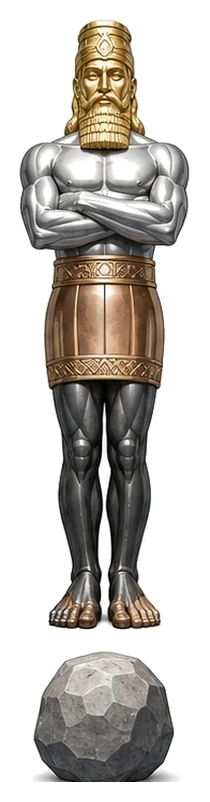
Head of Gold
Babylon / Nebuchadnezzar
Daniel directly identifies Nebuchadnezzar as the head of gold. Because Nebuchadnezzar is the king of Babylon, the first kingdom identification is grounded in the chapter itself.
Chest and Arms of Silver
Medo-Persia
Daniel 2 directly says another kingdom follows Babylon, but it does not name that kingdom. BPG correlates the silver kingdom with Medo-Persia by comparing the succession with Daniel 8, where the ram is explicitly identified as Media and Persia.
Belly and Thighs of Bronze
Greece
Daniel 2 calls this the third kingdom but does not name it. BPG correlates it with Greece because Daniel 8 explicitly identifies the goat as Greece in the same broad succession after Medo-Persia.
Legs of Iron
Rome
Daniel 2 describes a fourth kingdom strong as iron but does not name it. The traditional historicist reading correlates the fourth kingdom with Rome as the power that succeeds the Hellenistic Greek world in the prophetic sequence.
Feet of Iron and Clay
A divided kingdom
Daniel directly says the kingdom will be divided, partly strong and partly fragile, and that the mixed elements will not permanently cleave together. Historicist interpretation applies this divided phase to the successor kingdoms that followed the Western Roman political order.
Stone Cut Without Hands
God's everlasting kingdom
Daniel explains the climax directly: the God of heaven will set up a kingdom that will never be destroyed and will ultimately replace the kingdoms represented by the image.
Historical correlation: where the dates come from
The calendar markers often printed beside the Daniel 2 metals are historical teaching markers. They are useful, but they should never be displayed as if Daniel 2 itself supplied the dates.
539 BC
Babylon falls to Persian rule
The Babylonian Chronicle places the Persian capture of Babylon in 539 BC. This historical marker helps explain the transition from Babylon to the Medo-Persian phase.
External historical source331 BC
Alexander defeats Darius III
Alexander's decisive victory at Gaugamela in 331 BC shattered the Achaemenid field army and is a standard historical marker for the Greek conquest of Persia.
External historical source168 BC
Roman ascendancy over Macedonia
The Roman victory at Pydna in 168 BC ended the Antigonid Macedonian monarchy and is commonly used in historicist teaching as a transition marker toward Roman dominance. Rome's rise was a process, not a single instant.
External historical sourceAD 476
Conventional end of the Western imperial office
The deposition of Romulus Augustulus in AD 476 is commonly used as the conventional end marker for the Western Roman imperial office. The Eastern Roman Empire continued long afterward.
External historical sourceEvidence hierarchy: The historical sources establish events and dates. The correlation of those historical transitions with the silver, bronze, iron, and divided phases is the historicist interpretation used by BPG. History does not itself prove the prophetic identification, and Daniel 2 does not print these calendar dates.
The feet of iron and clay
Daniel's interpretation says the final phase is divided, partly strong and partly fragile. It also says the elements mingle but “shall not cleave one to another.” The chapter does not provide a list of modern nations or authorize every political event in Europe to be treated as a fulfillment.
BPG therefore keeps the application restrained: the historicist reading sees continuity from the iron kingdom into a divided political order rather than a fifth unified world empire. The text itself supplies the divided, mixed, and non-cleaving characteristics; the mapping to later European history is interpretation.
The chapter's climax: the stone kingdom
The God of heaven sets up a kingdom
Daniel 2 does not end by glorifying Babylon, Persia, Greece, Rome, or political fragmentation. The stone becomes the dominant image because God's kingdom is the point toward which the entire sequence moves.
“The God of heaven [shall] set up a kingdom, which shall never be destroyed.”
Daniel 2 and Daniel 7: the framework expands
Daniel 7 revisits the kingdom sequence with different symbols and adds details that Daniel 2 does not give. That relationship is why Daniel 2 should be treated as the foundation rather than as the final word on every kingdom.
Daniel 2
Metals and stone
Introduces the succession of kingdoms, division, and God's everlasting kingdom.
Daniel 7
Beasts, horns, judgment
Expands the same broad historical framework with additional political and religious details and the heavenly judgment scene.
Study principle
Let later chapters clarify earlier symbols
Use the explicit identifications in Daniel 8 and the expanded descriptions in Daniel 7 to test the historicist correlations rather than assuming every name from Daniel 2 alone.
How to study the evidence
- Read Daniel 2:31–45 first and mark only what Daniel explicitly says.
- Separate the one direct kingdom identification—Nebuchadnezzar/head of gold—from later correlations.
- Compare Daniel 8:20–21, where Media-Persia and Greece are named directly.
- Compare Daniel 7 for the expanded four-kingdom framework and the judgment/kingdom conclusion.
- Use historical sources for calendar transitions, then label those dates as history rather than Scripture.
- Keep the chapter's final emphasis where Daniel puts it: God's everlasting kingdom.