
Simple answer
Daniel 8 is a prophetic vision about Medo-Persia, Greece, a later little horn power, and a conflict involving God's sanctuary, truth, worship, and authority. The chapter introduces the 2300 days and points toward God's work of restoring truth after a long period of opposition.
Why Daniel 8 matters
Daniel 8 matters because it moves Bible prophecy from the rise and fall of kingdoms into a deeper spiritual conflict. Daniel 7 introduced the little horn and the heavenly judgment. Daniel 8 expands the picture by focusing on worship, the sanctuary, truth, and restoration.
This chapter is not merely about ancient history. It shows that the conflict in prophecy involves more than political power. It involves the truth of God, the worship of God, and the work of God on behalf of His people.
Daniel 8 should be studied carefully and patiently. It is one of the major bridge chapters between Daniel's kingdom prophecies and Revelation's final message.
Daniel 8 at a glance
Daniel 8 moves from the ram and the he-goat into the rise of the little horn, the conflict over truth and the sanctuary, and the promise that the sanctuary will be set right. Unlike some prophecy chapters, Daniel 8 identifies key symbols directly. The ram represents Medo-Persia, and the goat represents Greece.

The Ram: Medo-Persia
- Symbol clue: Two horns, with the higher horn rising last
- Biblical identification: The kings of Media and Persia
Scripture directly identifies the ram as the kings of Media and Persia. The unequal horns show an unequal partnership, with the higher horn rising later as the stronger power. This continues the kingdom sequence already introduced in Daniel 2 and Daniel 7.

The He-Goat: Greece
- Symbol clue: Great speed and one notable horn
- Biblical identification: Greece; the great horn is the first king
The goat's rapid movement emphasizes the speed of conquest. Daniel 8 directly identifies the kingdom as Greece and the great horn as its first king, giving the interpretation within the chapter itself.

The Broken Great Horn and Four Horns
- Prophetic sequence: The great horn is broken at the height of its strength
- Biblical identification: Four kingdoms arise from the nation, but not with the first king's power
- Historical understanding: Greece after Alexander
The four-horn stage marks the division that follows the first king. The vision distinguishes the divided Greek phase from the single great-horn phase and shows that the successor kingdoms would not possess the first king's power.

The Little Horn Grows Exceedingly Great
- Symbol stage: One broken great horn, four notable horns, and one little horn
- Prophetic movement: The little horn grows exceedingly great
The vision now moves from the divided Greek stage into the little-horn conflict involving God's people, truth, worship, and the sanctuary.

Little Horn Magnifies Itself — Sanctuary Conflict
- Prophetic action: The horn advances beyond political conquest into opposition involving the host, truth, worship, and the sanctuary
- Visual continuity: The enlarged horn remains connected to the four-horn stage of the he-goat vision
The vision now shows what the little horn does after it emerges. It magnifies itself, reaches upward in opposition, and becomes associated with the casting down of truth and the sanctuary conflict described in Daniel 8:10–12.
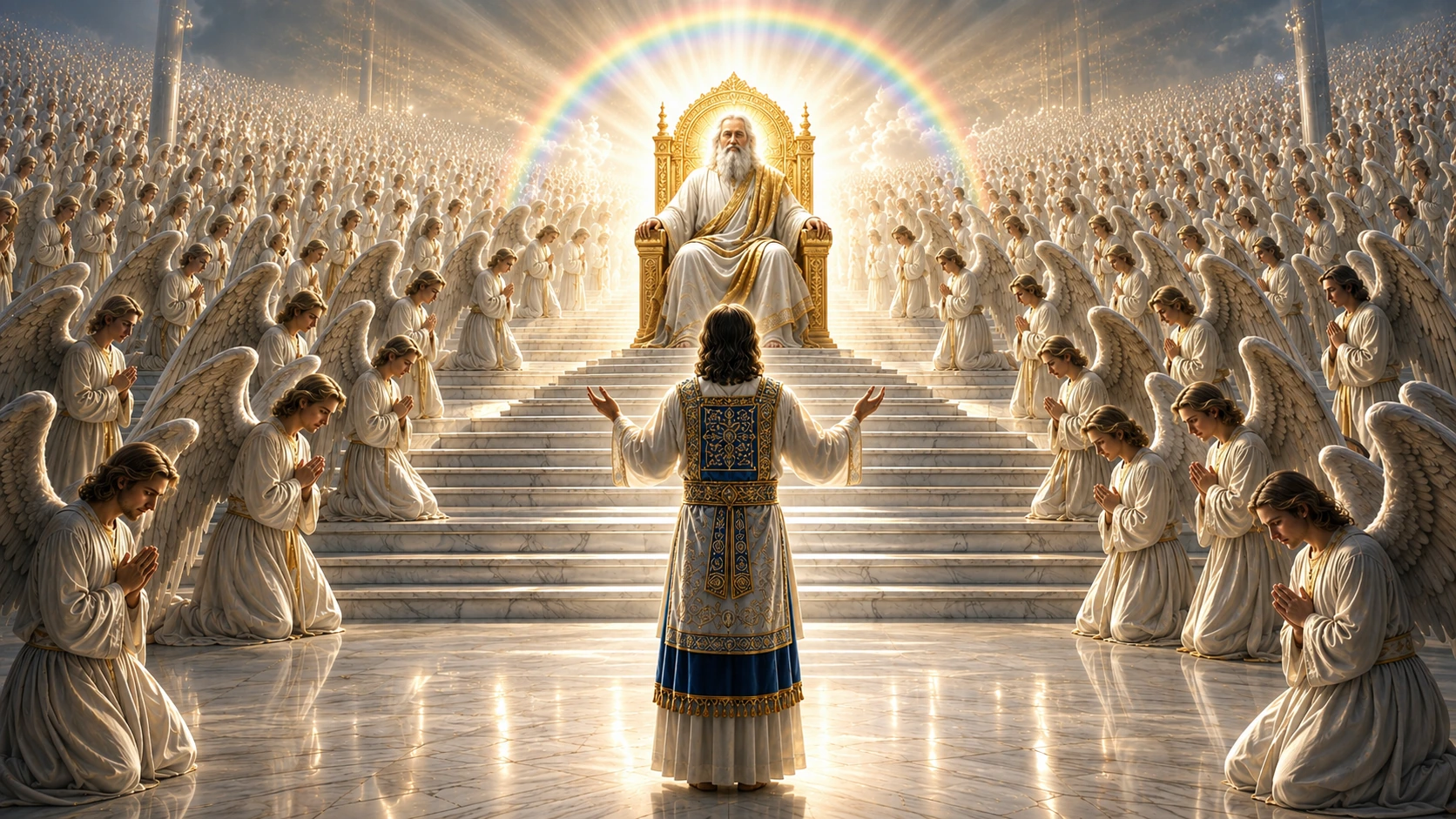
The Sanctuary Cleansed — Heavenly Court
- Prophetic answer: The sanctuary is cleansed, restored, or set right
- BPG study emphasis: Christ ministers before the Father in the heavenly court
In the Bible Prophecy Guide historicist sanctuary framework, Daniel 8 does not end with the triumph of the little horn. God's answer is the setting right of the sanctuary, shown here in the heavenly court with Christ ministering before the Father and the worshiping host of heaven.
Daniel 7 and Daniel 8: shared little-horn themes
Daniel 8's little horn grows exceedingly great and moves beyond ordinary conquest into a spiritual conflict. It exalts itself, acts against God's people, casts truth to the ground, and is connected with opposition to the sanctuary and God's work.
The little horn of Daniel 8 should be studied alongside the little horn of Daniel 7. The details are not identical because the chapters emphasize different aspects, but the themes overlap: arrogance, opposition to God, persecution, false authority, and a challenge to God's truth.
Daniel 8 adds an important layer. The conflict is not only against God's people. It is also against truth, worship, and the sanctuary message.
| Daniel 7 | Daniel 8 | Shared Emphasis |
|---|---|---|
| Little horn speaks against God | Little horn exalts itself | Counterfeit authority |
| Persecutes the saints | Acts against God's people | Opposition to God's faithful |
| Thinks to change times and law | Casts truth to the ground | Attack on divine truth |
| Judgment scene follows | Sanctuary restoration is promised | God answers the conflict |
Truth cast down
One of the most serious statements in Daniel 8 is that truth is cast down to the ground. This is not merely political language. It describes a spiritual attack on the truth of God.
When truth is cast down, people can still be religious while being misled. Worship can continue while God's Word is obscured. Authority can be claimed while Scripture is set aside.
This is one reason Daniel 8 matters so much. It teaches that the battle in prophecy is not just over territory or kingdoms. It is over truth.
The sanctuary question
Daniel 8 introduces the sanctuary as a major prophetic theme. The chapter asks how long the vision will last and points to a time when the sanctuary will be restored, cleansed, or set right.
This subject should be approached carefully. For many readers, the sanctuary is unfamiliar. But in the Bible, the sanctuary is connected with worship, sacrifice, priestly ministry, forgiveness, judgment, and God's plan of salvation.
Daniel 8 does not ask the reader to understand every detail at once. It opens a door into a deeper study of God's work to deal with sin, restore truth, and bring history to accountability.
How the sanctuary conclusion is built
Direct Scripture
Daniel's sanctuary question
Daniel 8:13–14 asks how long the sanctuary/trampling conflict continues and answers with the 2300 evening-mornings and the sanctuary being cleansed, restored, or set right.
Biblical background
Sanctuary cleansing in Leviticus
Leviticus 16:16, 16:30, and 16:33 place cleansing/atonement language inside the Day of Atonement sanctuary framework.
New Testament connection
Christ ministers in the heavenly sanctuary
Hebrews 8:1–2, 9:11–12, and 9:23–24 identify Christ as High Priest in the greater heavenly sanctuary and say He appears in God's presence for us.
Biblical comparison
Daniel 7's heavenly court
Daniel 7:9–10 and 7:13–14 show a heavenly court, opened books, judgment, and the Son of Man receiving the kingdom. BPG compares this with Daniel 8 without claiming the chapters themselves state an identical scene or date.
Historicist synthesis
Sanctuary restoration and heavenly ministry
BPG therefore reads Daniel 8's sanctuary resolution in the larger biblical sanctuary/judgment framework. The heavenly-sanctuary conclusion comes from comparing Daniel, Leviticus, and Hebrews; it is not wording printed in Daniel 8:14 alone.
Evidence boundary
This chain explains the sanctuary conclusion before chronology is added. The separate 2300-days study handles the day-year and historical date argument; Daniel 8:14 itself does not print “1844.”
The 2300 days
Daniel 8 includes the prophecy of the 2300 days. This is one of the most significant time prophecies in Daniel and has been studied carefully by many students of Bible prophecy.
The key point at this stage is not to rush into a conclusion. The 2300 days must be studied in connection with Daniel 8 and Daniel 9. Daniel 8 introduces the time period, while Daniel 9 provides essential timing connected with the Messiah.
Because this prophecy is deep, it belongs in a careful learning path. Daniel 8 introduces it, and the dedicated 2300-days study traces the Daniel 8 and Daniel 9 timing chain more fully.
God's answer: restoration of truth
Daniel 8 does not end with truth permanently cast down. The chapter points toward God's answer. The sanctuary will be set right. Truth will not remain buried. God's work will not be defeated.
In BPG's historicist sanctuary framework, this answer is understood through the evidence chain above: Daniel's sanctuary language, the Leviticus cleansing pattern, Christ's heavenly priestly ministry in Hebrews, and Daniel 7's heavenly judgment scene. The conclusion is therefore a cross-Scripture synthesis rather than a phrase contained in Daniel 8:14 by itself.
This is important because Bible prophecy is not only about exposing error. It is also about God's work of restoration. God restores truth. God restores worship. God restores confidence in His Word.
The final emphasis is not the power of the little horn. The final emphasis is God's ability to answer deception and bring truth back into view.
How Daniel 8 connects with Revelation
Daniel 8 prepares the reader for major themes in Revelation: worship, truth, false authority, judgment, and God's final appeal to the world. Revelation's messages become clearer when Daniel's sanctuary and truth themes are understood.
| Daniel 8 Theme | Revelation Connection |
|---|---|
| Truth cast down | Final call out of deception |
| False authority | Beast power and worship conflict |
| Sanctuary restoration | Judgment and worship themes |
| Prophetic time | End-time proclamation |
| God answers the conflict | Three Angels' Messages and final restoration |
How to study Daniel 8 responsibly
Daniel 8 should be studied in stages. Begin with what the angel directly identifies. Then compare the chapter with Daniel 2, Daniel 7, and Daniel 9. Avoid forcing all details into a single quick answer.
- Start with the ram and goat because the Bible identifies them.
- Compare the little horn of Daniel 8 with the little horn of Daniel 7.
- Notice the themes of truth, worship, and sanctuary.
- Study the 2300 days with Daniel 9 before drawing conclusions.
- Keep God's restoration of truth as the main emphasis.
Recommended next study
Continue with the 2300 days
Trace Daniel 8:14 through Daniel 9, Ezra 7, the day-year principle, and the historical chronology that leads to 1844.
Study the 2300 daysFrequently asked questions
What is Daniel 8 about?
Daniel 8 is a prophecy about the ram, the goat, the little horn, the sanctuary, the 2300 days, and God's promise to restore truth.
Who does the ram represent?
Daniel 8 identifies the ram as Medo-Persia.
Who does the goat represent?
Daniel 8 identifies the goat as Greece.
What are the 2300 days?
The 2300 days are a major prophetic time period introduced in Daniel 8. They should be studied together with Daniel 9 before drawing final conclusions.